
Congenital X-Linked Retinoschisis (XLRS)
Congenital X-linked retinoschisis (XLRS), also called X-linked juvenile retinoschisis, is a rare inherited retinal disease that affects the structure of the retina and causes reduced vision, usually beginning in childhood.
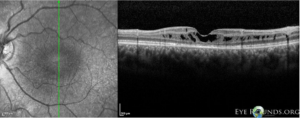
The word “retinoschisis” means “splitting of the retina.” In XLRS, layers of the retina separate from one another, most commonly in the macula, the central part of the retina responsible for sharp vision. This separation interferes with how visual signals are processed.
XLRS primarily affects boys and young men because the condition is inherited through the X chromosome.
What Causes XLRS?
XLRS is caused by mutations in the RS1 gene, which helps retinal cells stay properly connected and organized.
Because the condition is inherited in an X-linked pattern:
- Males are most commonly affected
- Females are usually carriers
- A family history of the condition may be present
The disorder is congenital, meaning it is present from birth, although symptoms are often noticed during school-age years.
How Does XLRS Affect Vision?
The splitting of retinal layers can disrupt central vision and sometimes peripheral vision.
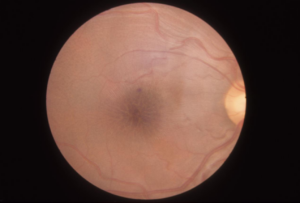
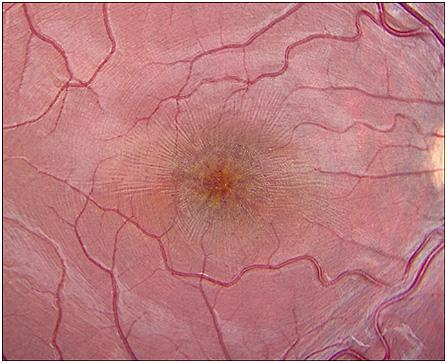
In many patients, the central retina develops a characteristic spoke-wheel pattern that can be seen during an eye examination.
Over time, complications such as retinal detachment or bleeding inside the eye can occur.
Symptoms of XLRS
Symptoms usually begin in childhood and may vary in severity.
Common symptoms include:
- Blurred central vision
- Difficulty reading
- Trouble seeing fine details
- Poor depth perception
- Eye wandering or misalignment in some children
- Difficulty in school related to visual tasks
Some patients may also develop:
- Peripheral vision problems
- Floaters
- Sudden vision changes from retinal complications
Vision is often reduced in both eyes.
How Is XLRS Diagnosed?
A retinal specialist can diagnose XLRS using a combination of eye examination, imaging, and genetic testing.
Dilated Eye Examination
The retina may show characteristic splitting or cyst-like spaces in the macula.
Optical Coherence Tomography (OCT)
OCT is one of the most important tests for XLRS. It creates detailed cross-sectional images of the retina and clearly shows the splitting between retinal layers.
Electroretinography (ERG)
ERG measures the electrical activity of the retina and may show characteristic abnormalities in XLRS.
Genetic Testing
Genetic testing can confirm mutations in the RS1 gene and help with family counseling.
Complications of XLRS
Although many patients maintain stable vision for years, complications can occur.
Possible complications include:
- Retinal detachment
- Vitreous hemorrhage (bleeding inside the eye)
- Progressive retinal damage
- Further vision loss
These complications require prompt evaluation by a retina specialist.
Treatment for XLRS
Observation and Monitoring
Regular retinal examinations and OCT imaging are important to monitor retinal structure and vision changes.
Glasses and Low Vision Support
Many children benefit from:
- Corrective glasses
- Educational accommodations
- Low vision aids
- Enlarged print materials
Carbonic Anhydrase Inhibitor Eye Drops
Some patients may benefit from medicated eye drops, such as topical carbonic anhydrase inhibitors, which may help reduce cystic retinal changes.
Surgery
Surgery may be needed if complications such as retinal detachment or vitreous hemorrhage occur.
Research and Gene Therapy
Researchers are actively studying gene therapy and other treatments for XLRS. Clinical trials continue to explore ways to improve retinal function and slow disease progression.

What Is the Prognosis?
Vision in XLRS varies from person to person.
Many patients:
- Maintain useful vision for many years
- Have stable or slowly progressive disease
- Adapt well with visual support tools
Some patients may experience worsening vision due to complications or progressive retinal changes.
Regular monitoring is important throughout life.
Living With XLRS
Children and adults with XLRS may benefit from:
- Regular retina specialist visits
- Educational accommodations at school
- Low vision services
- Protective eyewear during sports
- Prompt evaluation of sudden vision changes
Family members may also consider genetic counseling.
Frequently Asked Questions (FAQ)
Is XLRS inherited?
Yes. XLRS is an inherited genetic condition caused by mutations in the RS1 gene and follows an X-linked inheritance pattern.
Can XLRS cause blindness?
Severe vision loss is possible in some patients, especially if complications develop, but many individuals maintain useful vision throughout life.
Is there a cure for XLRS?
There is currently no cure, but research into gene therapy and new treatments is ongoing.