
If you or a loved one has wet age-related macular degeneration (wet AMD), you’ve probably heard two things over and over: treat it early and keep up with your injections. That advice is still true—but the good news is that treatment is rapidly evolving. Newer therapies are aiming to maintain vision with fewer office visits, offer more durable control of leakage and bleeding, and even explore one-time or infrequent treatments that could reduce the need for ongoing injections.
What Makes Wet AMD “Wet”?
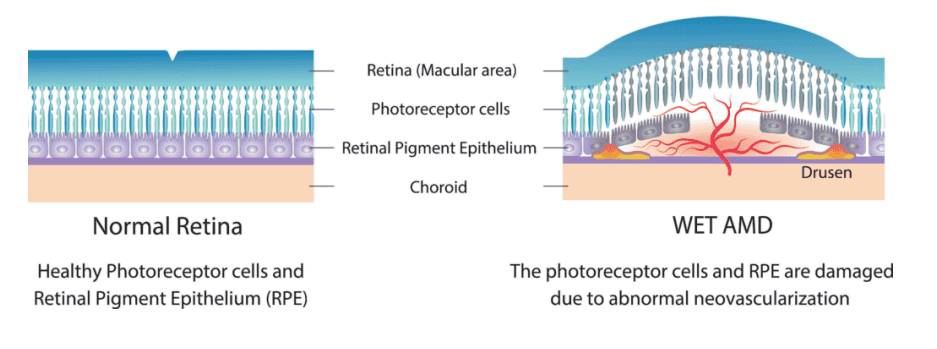
Wet AMD happens when abnormal blood vessels grow under the macula (the central part of your retina responsible for sharp vision). These vessels can leak fluid or bleed, causing distortion, blurry central vision, and sometimes a sudden drop in reading vision.
The Backbone of Modern Care: Anti-VEGF Injections
For years, the mainstay treatment has been medications that block VEGF (vascular endothelial growth factor), a signal that drives abnormal vessel growth and leakage. These medicines are delivered by intravitreal injection (a tiny injection into the eye performed with numbing drops and antiseptic).
Higher-Dose Anti-VEGF: Longer Durability
One major advance is higher-dose formulations designed to keep the retina dry for longer stretches in many patients. For example, aflibercept 8 mg has dosing strategies that can extend intervals after the initial monthly doses, with labeling that includes longer maintenance intervals in appropriate patients.
Why this matters: fewer injections can mean fewer appointments, less travel burden, and less disruption—especially for patients relying on family or caregivers.
Treat-and-Extend Strategy
Many retina practices use a strategy called treat-and-extend: after the macula is dry and stable, visits are gradually spaced out (for example, 6 → 8 → 10 → 12+ weeks), as long as fluid doesn’t return. The best interval is the one that keeps your macula stable.
Implant-Based Delivery Options
Some patients do well on injections but feel worn down by frequent visits. An implant-based delivery system can continuously release medication over months, with in-office refills at set intervals. For select patients, this may reduce the frequency of traditional injections.
This approach requires careful patient selection, monitoring, and discussion of risks and benefits with your retina specialist.
Gene Therapy and Long-Lasting Research
Researchers are working toward treatments that could last many months—or potentially years—after a single procedure. One of the most exciting areas is gene therapy, where the goal is to help the eye produce an anti-VEGF-like protein on its own.
While promising, gene therapy for wet AMD remains in clinical trials and is not yet a standard treatment. Patients interested in research studies should discuss eligibility with their retina specialist.
Better Imaging Means Personalized Care
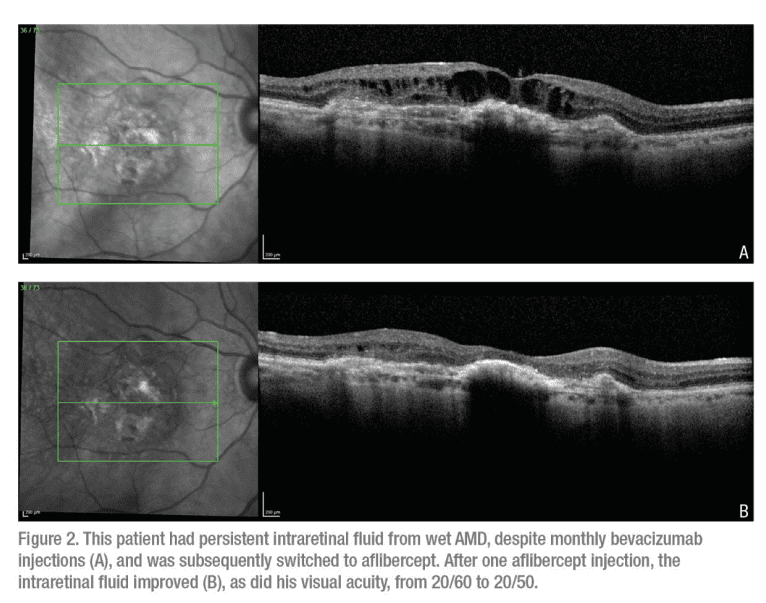
High-resolution OCT scans allow your doctor to see fluid and retinal anatomy in seconds.
These scans guide decisions about whether to treat, switch medications, or extend treatment intervals.
Practical Takeaways for Patients
-
If you’re newly diagnosed:
- Start treatment quickly to preserve central vision.
- Expect more frequent visits early, then possible extension once stable.
- If you’re stable but tired of frequent visits:
- Ask about longer-interval strategies.
- Discuss higher-dose or implant-based options if appropriate.
- If you’re not responding as hoped: Your doctor may discuss switching medications or adjusting intervals.
Questions to Ask at Your Next Visit
- Is my macula dry on OCT today?
- What treatment interval keeps my eye stable?
- Am I a candidate for longer-lasting treatment options?
- Do I qualify for any clinical trials?
- What symptoms should trigger an urgent call?