
Central Serous Chorioretinopathy (CSCR)
Central serous chorioretinopathy (CSCR), sometimes called central serous retinopathy (CSR), is a retinal condition in which fluid builds up underneath the retina, causing blurred or distorted central vision. The condition affects the macula, the part of the retina responsible for sharp vision needed for reading, driving, and recognizing faces.
CSCR most commonly affects adults between the ages of 30 and 60 and tends to occur more often in men. In many cases, CSCR improves on its own, but some patients experience recurrent episodes or long-term visual changes.
What Causes CSCR?
CSCR occurs when fluid leaks underneath the retina from a layer of blood vessels called the choroid. This fluid causes the retina to lift slightly, leading to blurry or distorted vision.
The exact cause is not fully understood, but several risk factors are associated with CSCR:
- Stress
- Use of corticosteroid medications
- Type A personality traits
- High blood pressure
- Sleep disturbances
- Pregnancy
- Obstructive sleep apnea
Steroid medications are one of the strongest known risk factors. CSCR may occur with:
- Oral steroids
- Steroid creams
- Nasal sprays
- Inhalers
- Steroid injections
Patients should never stop prescribed steroid medications without discussing it with their physician.
Symptoms of CSCR
Symptoms often appear suddenly and usually affect one eye, although both eyes can sometimes be involved.
Common symptoms include:
- Blurred central vision
- Distorted vision (straight lines appear bent)
- Objects appearing smaller or farther away
- A dark or gray spot in central vision
- Reduced color intensity
- Difficulty reading
Some patients describe vision as looking “dim” or “washed out.”
Peripheral vision is usually normal.
How Is CSCR Diagnosed?
A retinal specialist can diagnose CSCR during a dilated eye examination and with specialized retinal imaging.
Optical Coherence Tomography (OCT)
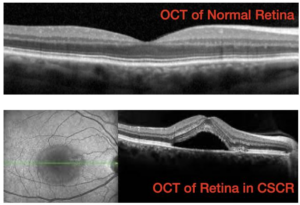
OCT is the most important test for CSCR. It creates detailed cross-sectional images of the retina and shows fluid beneath the macula.
Fluorescein Angiography
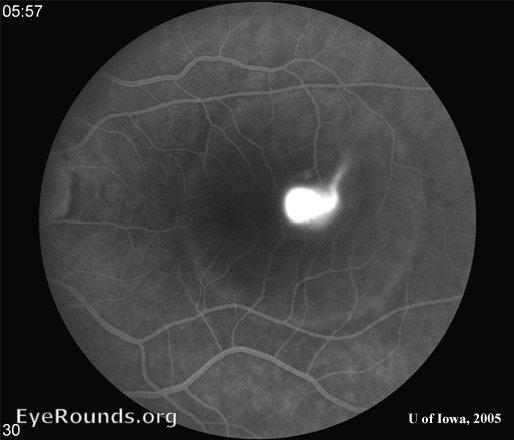
This test uses fluorescent dye injected into a vein in the arm to identify leakage points underneath the retina.
Indocyanine Green Angiography (ICG)
ICG imaging may help evaluate abnormal choroidal blood vessels and guide treatment decisions in chronic cases.
Fundus Photography
Retinal photographs help document the appearance and progression of the condition.
Acute vs. Chronic CSCR
Acute CSCR
Many patients experience a single episode that resolves on its own within several weeks to months.
Vision often improves significantly as the fluid disappears.
Chronic CSCR
In some patients, fluid persists or repeatedly returns over time. Chronic fluid can damage the retina and lead to permanent visual symptoms.
Long-standing CSCR may cause:
- Retinal thinning
- Permanent distortion
- Reduced contrast sensitivity
- Vision loss
Treatment for CSCR
Observation
Because many cases improve naturally, initial treatment often involves careful monitoring.
Your retina specialist may recommend:
- Regular OCT imaging
- Avoiding steroid medications when possible
- Stress reduction strategies
Photodynamic Therapy (PDT)
PDT is one of the most effective treatments for chronic CSCR. This procedure uses a light-activated medication and laser treatment to reduce abnormal leakage beneath the retina.
Laser Treatment
In selected cases, focal laser treatment may be used to seal specific leakage points.
Medications
Certain oral medications may sometimes help reduce fluid in chronic cases, although results vary.
What Is the Prognosis?
The outlook for many patients with CSCR is good, especially in first-time acute cases.
However, some patients continue to experience:
- Mild distortion
- Decreased contrast sensitivity
- Blurry vision
- Recurrent episodes
Chronic or recurrent CSCR may lead to more permanent retinal damage.
Regular follow-up with a retina specialist is important to monitor recovery and detect recurrence.
Living With CSCR
Patients with CSCR should:
- Avoid unnecessary steroid medications when possible
- Manage stress levels
- Keep follow-up appointments
- Report worsening vision promptly
- Discuss sleep apnea evaluation if appropriate
Many patients recover useful vision, although subtle visual symptoms may persist.
Frequently Asked Questions (FAQ)
Can stress really cause CSCR?
Stress is strongly associated with CSCR and may contribute to changes in hormones and blood vessel function that increase fluid leakage beneath the retina.
Will my vision return to normal?
Many patients recover most of their vision after the fluid resolves. However, some patients may continue to notice mild distortion or blurry vision.
Is CSCR permanent?
Many cases are temporary, but chronic or recurrent CSCR can sometimes cause permanent retinal damage and long-term visual symptoms.