
Stargardt Disease
Stargardt disease is the most common form of inherited macular degeneration in children and young adults. It causes progressive damage to the macula, the part of the retina responsible for sharp central vision needed for reading, recognizing faces, and seeing fine details.
Although Stargardt disease can significantly affect central vision, it does not usually lead to complete blindness. Most people retain their peripheral (side) vision and can continue to lead active, independent lives with appropriate support and monitoring.
While there is currently no approved cure for Stargardt disease, ongoing research in gene therapy, stem cell treatments, and other emerging therapies offers hope for future treatment options.
What Is the Macula?
The retina is the light-sensitive tissue lining the back of the eye. At the center of the retina is the macula, which provides:
- Sharp central vision
- Detailed vision needed for reading
- Color perception
- The ability to recognize faces
- Fine visual tasks such as driving and using electronic devices
In Stargardt disease, cells within the macula gradually become damaged, resulting in progressive central vision loss.
What Causes Stargardt Disease?
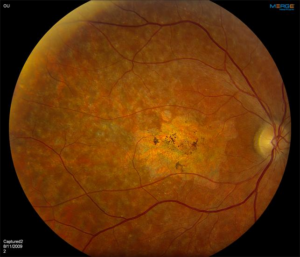 Stargardt disease is an inherited condition caused most commonly by mutations in the ABCA4 gene.
The ABCA4 gene helps photoreceptor cells remove waste products generated during the normal visual cycle. When this gene does not function properly, fatty waste material called lipofuscin accumulates within the retinal pigment epithelium (RPE).
Over time, this buildup damages the retinal cells responsible for central vision.
Most cases follow an autosomal recessive inheritance pattern, meaning:
- A child inherits one abnormal gene from each parent.
- Parents are typically unaffected carriers.
- Each pregnancy has a 25% chance of producing an affected child if both parents carry the mutation.
Less commonly, Stargardt-like diseases can result from mutations in other genes.
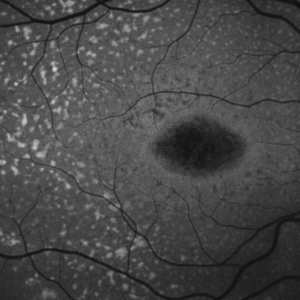
What Are the Symptoms of Stargardt Disease?
Symptoms often begin during childhood, adolescence, or early adulthood, although some people are diagnosed later in life.
Common symptoms include:
Blurred Central Vision
Patients may notice difficulty:
- Reading small print
- Recognizing faces
- Seeing fine details
- Performing visually demanding tasks
Slow Vision Loss
Vision changes often progress gradually over time.
Difficulty Adapting to Changes in Lighting
Some individuals have trouble adjusting when moving between bright and dim environments.
Reduced Color Vision
Colors may appear less vivid.
Central Blind Spots
As the disease progresses, patients may develop areas of missing vision in the center of their visual field.
Importantly, peripheral vision is usually preserved, allowing most patients to maintain mobility and orientation.
How Is Stargardt Disease Diagnosed?
A retina specialist can diagnose Stargardt disease using a combination of examination findings, imaging studies, and genetic testing.
Dilated Retinal Examination
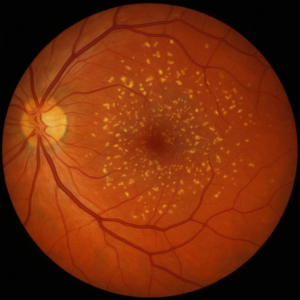
The retina may show characteristic findings, including:
- Yellow-white flecks called pisciform flecks
- Areas of macular atrophy
- Changes in the retinal pigment epithelium
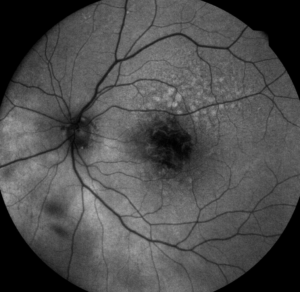
Fundus Autofluorescence
This imaging technique highlights lipofuscin accumulation and can help monitor disease progression.
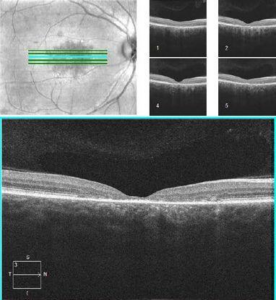
Optical Coherence Tomography (OCT)
OCT provides detailed cross-sectional images of the retina and may reveal:
- Loss of photoreceptor cells
- Thinning of the macula
- Areas of retinal atrophy
Visual Field Testing
Testing may identify central blind spots.
Electroretinography (ERG)
ERG evaluates retinal function and may help characterize disease severity.
Genetic Testing
Genetic testing can:
- Confirm the diagnosis
- Identify the responsible mutation
- Provide information about inheritance
- Determine eligibility for future clinical trials
How Is Stargardt Disease Treated?
At present, there is no FDA-approved treatment that reverses Stargardt disease. However, several approaches can help patients maximize vision and prepare for future therapeutic advances.
Low Vision Rehabilitation
Low vision specialists can provide tools and strategies such as:
- Magnifying devices
- Electronic reading aids
- Adaptive technology
- Smartphone accessibility features
- Educational accommodations
Genetic Counseling
Genetic counseling helps patients and families understand:
- Inheritance patterns
- Risks for family members
- Reproductive considerations
- Eligibility for genetic testing
Clinical Trials
Researchers are actively studying treatments including:
- Gene therapies
- Stem cell therapies
- Visual cycle modulators
- Complement inhibitors
- Cell-based therapies
Patients interested in research opportunities may benefit from referral to centers participating in inherited retinal disease trials.
Nutritional Considerations
Because Stargardt disease involves lipofuscin accumulation, some specialists recommend avoiding high-dose vitamin A supplements unless specifically advised by your physician.
Patients should discuss any supplements with their healthcare team before starting them.
What Is the Prognosis?
The course of Stargardt disease varies from person to person.
Many patients experience:
- Gradual loss of central vision over years
- Stable peripheral vision
- Preservation of independence with adaptive strategies
The rate of progression depends on factors such as:
- The underlying genetic mutation
- Age at symptom onset
- Severity of retinal involvement
Although central vision loss can be challenging, complete blindness is uncommon.
Living With Stargardt Disease
Living with Stargardt disease often involves adapting to changes in vision while maintaining independence and quality of life.
Helpful strategies include:
- Scheduling regular retinal examinations.
- Considering genetic testing and counseling.
- Using low vision resources and assistive devices.
- Exploring educational and workplace accommodations.
- Protecting the eyes from excessive sunlight with UV-protective eyewear.
- Staying informed about clinical trials and emerging therapies.
Support organizations can provide valuable education, advocacy, and connections with others living with inherited retinal diseases.
Frequently Asked Questions (FAQ)
Will Stargardt disease cause complete blindness?
Usually not. Most people retain peripheral vision, although central vision can decline significantly over time.
Is Stargardt disease inherited?
Yes. Most cases are caused by inherited mutations in the ABCA4 gene and follow an autosomal recessive inheritance pattern.
Is there a cure for Stargardt disease?
There is currently no approved cure, but research involving gene therapy, stem cell treatments, and other approaches continues to advance rapidly.