
Stickler Syndrome
Stickler syndrome is a hereditary connective tissue disorder that can affect the eyes, ears, joints, and facial development. In the eye, Stickler syndrome is especially important because it significantly increases the risk of retinal tears and retinal detachment, which can lead to permanent vision loss if not recognized and treated promptly.
Although Stickler syndrome is a lifelong condition, early diagnosis, regular monitoring, and appropriate treatment can help preserve vision and improve quality of life. Because multiple body systems may be involved, patients often benefit from care provided by a team of specialists.
What Is Stickler Syndrome?
Stickler syndrome is a genetic disorder that affects the body’s connective tissues, particularly collagen. Collagen is an important structural protein found throughout the body, including the eyes, joints, cartilage, and inner ear.
Several different genes can cause Stickler syndrome, most commonly:
- COL2A1
- COL11A1
- COL11A2
- Less commonly, COL9A1, COL9A2, and COL9A3
Most forms are inherited in an autosomal dominant pattern, meaning that a parent with the condition has a 50% chance of passing it on to each child.
How Does Stickler Syndrome Affect the Eyes?
The eye findings associated with Stickler syndrome are often among the most serious aspects of the condition.
Common eye problems include:
- High myopia (significant nearsightedness)
- Abnormal vitreous development
- Lattice degeneration
- Retinal tears
- Retinal detachment
- Early cataracts
- Glaucoma
The risk of retinal detachment is substantially higher than in the general population and can occur at a young age.
What Other Symptoms Can Occur?
Because Stickler syndrome affects connective tissue throughout the body, symptoms can vary considerably.
Hearing Problems
Some patients experience:
- Sensorineural hearing loss
- Conductive hearing loss
- Progressive hearing changes
Joint and Skeletal Problems
Symptoms may include:
- Joint pain
- Joint stiffness
- Early arthritis
- Hypermobile joints
- Scoliosis
- Spine abnormalities
Facial Features
Certain facial characteristics may be present, including:
- Flattened facial appearance
- Small lower jaw (micrognathia)
- Cleft palate
- Pierre Robin sequence
Not every person with Stickler syndrome has all of these features.
What Are the Symptoms of Eye Complications?
Many patients have no symptoms until complications develop.
Symptoms that require urgent evaluation include:
- Sudden flashes of light
- New floaters
- A curtain or shadow in the vision
- Sudden loss of peripheral vision
- Blurred vision
- Sudden decrease in vision
These symptoms may indicate a retinal tear or retinal detachment.
How Is Stickler Syndrome Diagnosed?
Diagnosis is based on a combination of clinical findings, family history, and genetic testing.
Comprehensive Eye Examination
A retina specialist evaluates for:
- High myopia
- Vitreous abnormalities
- Lattice degeneration
- Retinal tears
- Retinal detachment
Dilated Retinal Examination
Careful examination of the peripheral retina is particularly important.
Genetic Testing
Genetic testing can:
- Confirm the diagnosis
- Identify the responsible mutation
- Clarify inheritance patterns
- Help guide family screening
Additional Evaluations
Depending on symptoms, patients may also undergo:
- Hearing assessments
- Orthopedic evaluations
- Craniofacial evaluations
- Genetic counseling
How Is Stickler Syndrome Managed?
There is no cure for Stickler syndrome, but many of its complications can be treated or prevented.
Regular Retinal Examinations
Because of the high risk of retinal detachment, routine retinal evaluations are essential.
Examinations may be recommended annually or more frequently depending on individual risk factors.
Prophylactic Retinal Treatment
In selected patients, preventive laser treatment or cryotherapy may be recommended to reduce the risk of retinal detachment.
The decision to pursue preventive treatment is individualized and should be discussed with a retina specialist familiar with Stickler syndrome.
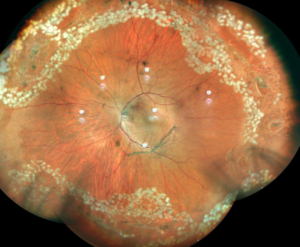
Treatment of Retinal Tears
Retinal tears are often treated with:
- Laser retinopexy
- Cryotherapy
Prompt treatment can reduce the risk of retinal detachment.
Retinal Detachment Surgery
If a retinal detachment develops, surgery may include:
- Scleral buckle surgery
- Pars plana vitrectomy
- Combined procedures
Treatment of Other Eye Conditions
Additional treatment may be needed for:
- Cataracts
- Glaucoma
- Refractive errors requiring glasses or contact lenses
What Is the Prognosis?
The outlook for patients with Stickler syndrome varies depending on the severity of the condition and whether retinal complications occur.
With appropriate monitoring:
- Many retinal tears can be treated before detachment develops.
- Vision can often be preserved.
- Hearing and orthopedic concerns can be managed effectively.
- Quality of life can remain excellent.
However, retinal detachments remain one of the most significant causes of vision loss in Stickler syndrome.
Living With Stickler Syndrome
If you or your child has Stickler syndrome:
- Schedule regular retinal examinations.
- Learn the warning signs of retinal detachment.
- Seek urgent evaluation for new flashes or floaters.
- Inform family members about the hereditary nature of the condition.
- Consider genetic counseling.
- Maintain follow-up with all recommended specialists.
Early recognition of complications provides the best opportunity to preserve vision and overall health.
Frequently Asked Questions (FAQ)
Is Stickler syndrome inherited?
Yes. Most forms of Stickler syndrome are inherited in an autosomal dominant pattern, although less common recessive forms also exist.
Can retinal detachments be prevented?
While they cannot always be prevented, regular retinal examinations and preventive treatment in selected patients may reduce the risk of retinal detachment.
Should family members be evaluated?
Yes. Because Stickler syndrome is often inherited, family members may benefit from eye examinations and genetic counseling.